


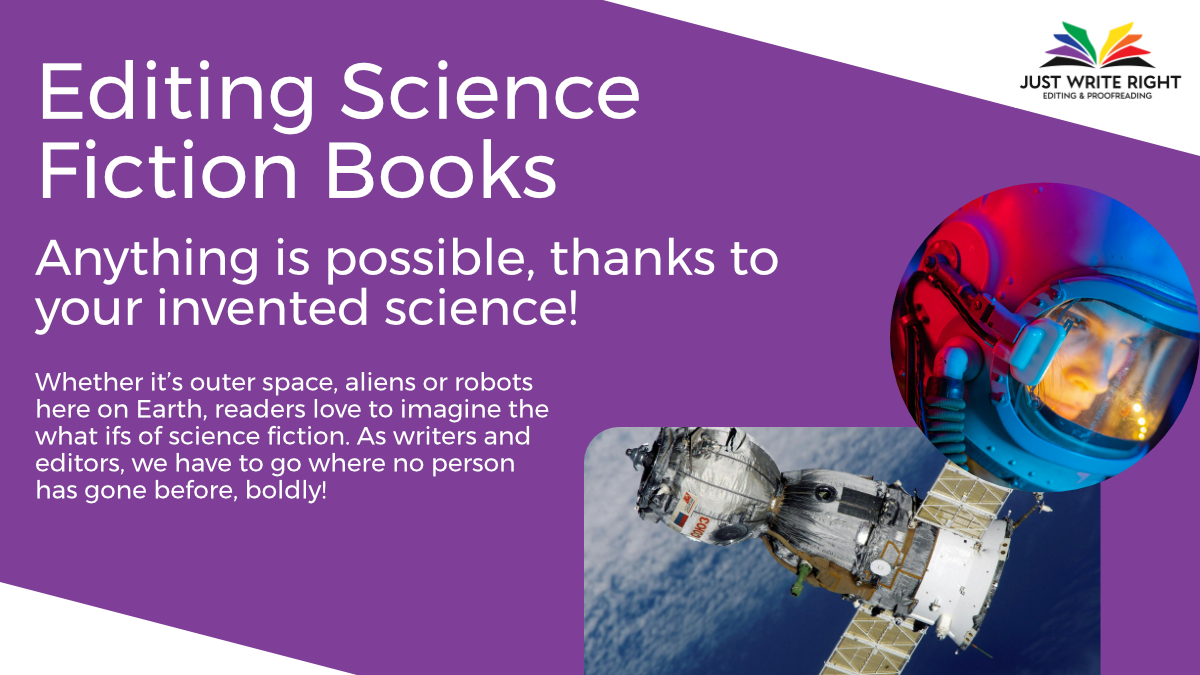
Whether it’s outer space, aliens or robots here on Earth, readers love to imagine the what ifs of science fiction. As writers and editors, we have to go where no person has gone before, boldly!
Writing science fiction
As with fantasy books, science fiction is all about taking readers out of the current world into a world where anything is possible, thanks to science. How realistic or imaginative you decide to create that is up to you.


Of course, there are many subgenres of science fiction, and we’re not going to be able to look at them all here, but this post will look at the guiding principles of all science fiction and how I, as an editor, approach your sci-fi manuscript.
The best way to learn is by reading. Read all the science fiction you can. Absorb it. Learn it. Be nerdy and write down everything about it. Identify what works and what doesn’t. Reading well is going to mean your writing is even better!
One thing to consider is reader expectations or tropes. I love this list from Kindlepreneur with lists of book tropes. Take a look at the fantasy section and see what readers are expecting from their fantasy books. Of course, don’t stray into cliché (a developmental edit will help)!
Before you write
Before you begin to write, you should take some time to consider the things in your sci-fi world.
- What are the rules of your worlds? Set out, for yourself, the important things that can and cannot be done in your imagined worlds so that everyone is playing by the same rules. Of course, characters could break the rules…
- Craft the societies, social hierarchies or other structures of the worlds you are creating. Like the rules, if you have an understanding of the world or universe you are writing, it will be consistent and clear for the reader.
- Engineer your tech. Whether it’s time travel with flux capacitors, hyperspace drives or sonic screwdrivers, your technology needs to be in place to work and you need to know how it works for your story to make sense. It’s no good inventing tech when a problem arises. Readers will work out that you are cheating them!


Once you have set the ground rules and thought about the world and technology, you need to think about the story. As with any fiction, it’s all about the problem to be overcome and how the characters get from the inciting incident to the resolution.
Character
Character is key. Whether they are human, humanoid or alien (or any hybrid!), it’s crucial that you write characters that are relatable and fully fleshed out (or whatever the android equivalent is!).
Whatever species or artificial intelligence your character is, they need relatable issues, flaws, wants and obstacles for readers to invest in them.
Queer science fiction


Given you don’t have to stick to the rules as we know them here on Earth, there is scope to create characters and scenarios as queer as you like! That could be playing with gender and sexuality in ways that wouldn’t be possible with human societies.
Indeed, sci-fi books are known for their diverse representation of sexualities and genders and this is something that you should certainly consider as you write your fantasy fiction novel.
Doing it well is important so that you don’t trivialise or have tokenistic characters. I offer bespoke support for this, so please get in touch today to find out more.
Developing your science fiction novel
If you come to me in the early stages of the process, a developmental edit will help you to create a manuscript that is structured well and takes your readers on the journey with your characters.
Developmental editing is all about the big picture of the story. Remember when you considered all the rules and the technology of your sci-fi world? This is one of the things I would look at during a developmental edit of your manuscript.
- Does the world make sense?
- Are there clear rules that are followed?
- Do the characters obey the rules of the world or break them deliberately?
Info dumping
Of course, building this world is tough and then writing about it tougher still. One of the many dangers of writing science fiction, like fantasy, is the dreaded “info dump” – where you spend paragraph after paragraph, chapter after chapter building your world, imparting all your knowledge, without any action taking place.
This is going to turn off some readers. (Others like it, so finding a balance and understanding your reader is key – read the genre!)


A developmental edit is going to identify any instances of this and help you to rewrite these sections with some action. It could be that:
- Some information can be removed as it isn’t needed
- Some information can be moved to a more appropriate section
- We need more information, as it comes in useful later on in the story
Developing characters
As part of the bigger picture, I help you to address any issues you may have in characterisation. While characters may not be human, readers are and so they need to see some human traits that help them to connect.

When developing science fiction characters, it’s important to consider everything that makes a good (or evil!) character – motivation, flaws, strengths, voice, etc. – but also what sci-fi elements are they bringing and how does this influence the character and the story? A developmental editor, who comes to your manuscript fresh, can help you to identify any potential weaknesses in your characterisation.
While we’re on the subject of character: do you have too many? A developmental edit is the ideal time for working out which of your characters are necessary and which are superfluous!
There are so many other things a developmental edit will look at:
- Your story’s structure
- The pace of the plot
- Your voice as a writer and the voices of the characters
- Point of view and shifting perspectives
- Cliché, metaphor and tropes
- And much, much more!
Getting a developmental edit early in the process allows you to consider all the feedback and advice you get so that your later drafts are the best they could possibly be.
Copyediting a science fiction book
Copyediting is the stage where your writing is polished and made ready for the reader. I take the text of your book and work with it sentence-by-sentence, addressing everything from spelling, punctuation and grammar to overall sense and flow.
I like to break copyediting down into these five C’s:
- Consistency
- Clarity
- Conciseness
- Correctness
- Conscious language


Creating a bespoke style sheet for your book, I will ensure that all style decisions, spelling variations, numbering systems, etc. are consistent across the book.
This is important in science fiction as often they include words that fit only their worlds with words for technologies and scientific elements with unique spellings and concepts that are named by the writer. Getting these muddled will only confuse the reader and take them out of the story which is why copyediting is so vital.
Copyediting is also the stage where I ensure that your book is clear for the reader, every sentence makes sense and that your writing is concise and to the point. If the concepts aren’t clear or your world doesn’t make sense, it’s going to put off the reader and they are not going to enjoy your writing.
We mentioned before about queer science fiction. If you are including queer characters and situations, it’s important that these are handled well with language that suits. As an LGBTQ+ language specialist, this is something that I can support you with at the copyediting stage.
Finally…
Once copyediting is complete, your text should be almost ready for your readers. After typesetting and formatting your book, a proofread will check for any last typos or errors and then you are good to go!
What fantasy fiction books have I worked on?
Here’s some of the fantasy novels I have worked on and that I can share with you here.


Nick (he/him) is an experienced, professional editor and proofreader, specialising in LGBTQ+ writing. Use this form to get in touch right now!
Thank you for your response. ✨
Receive my newsletter, Editing Queeries!
Your support helps!


Your Ko-fi donations help keep me blogging about writing and editing. They also ensure that I can create and provide free resources for editors and writers. Please consider buying me a cuppa!


Editorial services for fiction and non-fiction authors, businesses and organisations.
Leave a ReplyCancel reply