
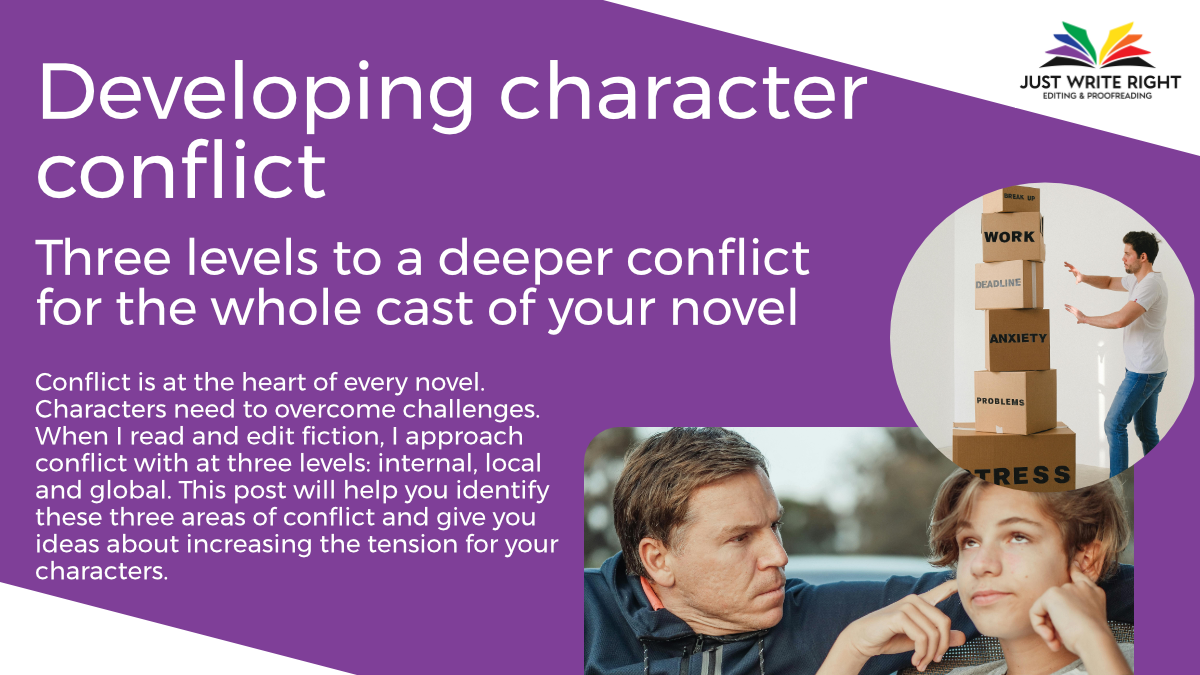
Conflict is at the heart of every novel. Characters need to overcome challenges. When I read and edit fiction, I approach conflict with at three levels: internal, local and global. This post will help you identify these three areas of conflict and give you ideas about increasing the tension for your characters.
Internal conflict

Internal conflicts all happen within the character’s head.
Fears and doubts, wants and desires, struggles with identity and a moral compass are all examples of internal conflict.
Consider how the morals of your character will impact on their decisions and how they will feel about how other characters in the novel are behaving.
Past experiences can lead to a lot of internal conflict. It’s essential to think about your character’s past life and how that will have an influence on their current problems and the way they deal with the situations you place them in.
Internal conflicts may be the driving force of your story, especially if you are writing a story where the main character transforms, overcomes a particular struggle with themselves. Coming of age novels also feature a lot of internal conflict.
All characters, whether they are the main character or playing a more supporting role, will have internal conflicts. While you may not directly explore these, you as the writer, should have an understanding of these internal struggles.
Local conflicts
Local conflicts happen with the people and situations closest to your characters.
This could be with family members, friends or people who your characters are in (or were in) romantic relationships with.
Conflicts can be because of others’ expectations or attitudes, behaviours or personality types.

Unless your character is completely isolated, there will be times when they come into contact with others. There will have to be tensions. Even the best relationships break down at times.
Pressures from other characters could set off internal conflicts. How someone reacts to another’s antagonism might differ depending on their past experiences.
Consider how you could use professional or educational relationships to increase drama and conflict too. Don’t forget, like internal conflicts, every character is going to be experiencing local conflicts so bear these in mind as you write.
Global conflicts

It’s time to think big and imagine the situation of the world outside of your characters’ immediate surroundings.
Global conflicts involve things outside of the character’s influence. There could be laws, values and religions that are, in some way, binding the character to behave in a certain way.
Think about how external events are going to cause tension for the characters in your novel. Although the events are outside of the character’s control, they will have an impact on them. Wars and politics, for example, can provide the background to some personal conflicts for characters.
Characters will have views of their surrounds that they may disagree with. How do they view their world and where are the tensions for them?
Upping the stakes
Conflict is essential in your writing. As you write, hold these three levels of conflict in your head and use them to consider how your characters act and react as a result of them.
Where you can, find ways to increase the conflict. That could be by increasing the internal conflict of the characters, or the local or global conflicts.
If you need help increasing the tension and conflict for your characters, consider how a beta reader or developmental editor could support you.
Nick (he/him) is an experienced, professional editor and proofreader, specialising in LGBTQ+ writing. Use this form to get in touch right now!


Receive my newsletter, Editing Queeries!
Your support helps!

Your Ko-fi donations help keep me blogging about writing and editing. They also ensure that I can create and provide free resources for editors and writers. Please consider buying me a cuppa!


Editorial services for fiction and non-fiction authors, businesses and organisations.
Leave a Reply